

Case Study – From Paper to 95% Digital: How the Latvian Chamber of Commerce Transformed Certificate of Origin Issuance

Background & Challenge
The Latvian Chamber of Commerce and Industry (LCCI) is one of the country’s principal issuers of non-preferential Certificates of Origin representing over 8,000 members. Prior to adopting essCert, certificate issuance was an entirely in-person, paper-based process – exporters visited the chamber in person, staff reviewed and physically signed documents, and copies had to be stored on-site.
Beyond the time cost of manual processing, the accumulation of physical copies created a growing storage burden. Leadership recognized that digitization was not simply an operational improvement, but a resilience and future-readiness imperative – a lesson underscored by the disruptions of the COVID-19 pandemic.
LCCI went live with essCert in May 2022. Within 10 months, the chamber had already reached 70% electronic adoption. This case study captures the full journey, with LCCI now operating at 95% digital certification.
Key Results

Chamber Benefits: Processing Time & Cost
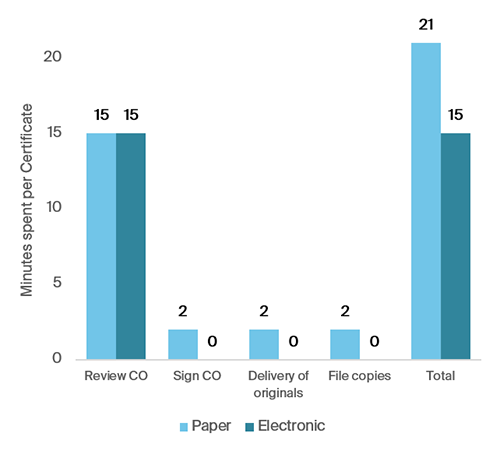
29% time reduction in CO processing
Signing, delivery of originals, and filing – previously requiring 2 minutes each per certificate – have been completely eliminated, saving 6 minutes per certificate. Electronic transmission means certificates reach applicants instantly, with no courier coordination and no physical archive to maintain.
Across LCCI's full certificate volume, this 6-minute total time saving per CO represents a significant recovery of staff time that can be redirected to higher-value member services.
The chamber also reported a 20% reduction in admin costs since switching to eCOs.
Driving Adoption: Pricing & Change Management
LCCI’s path to 95% adoption was the result of a deliberate combination of commercial incentive and hands-on support:
- Pricing incentive: A new pricing policy was introduced. Electronic certificates were priced lower than in-person equivalents, giving exporters a direct financial reason to make the switch.
- Training & encouragement: Both exporter members and internal staff received training and active encouragement throughout the transition.
- Leadership alignment: Management change at LCCI helped accelerate internal adoption, creating clear top-down commitment to the digital path.
Member & Exporter Benefits
The impact of digitalization extends well beyond the chamber’s own operations. Members and exporters using essCert have reported tangible improvements in speed, convenience and confidence:
- Instant digital delivery: Exporters receive their eCOs in seconds, eliminating the need to visit the chamber in person or wait for physical documents.
- High satisfaction: An 8/10 customer satisfaction score and a management-confirmed reduction in member complaints reflect the strong positive reception.
- Customs acceptance: Electronic certificates have been accepted without issue by customs authorities, supporting smooth trade flows for Latvian exporters.
- Crisis resilience: The digital infrastructure proved its value during disruption scenarios. LCCI cites improved readiness for events such as COVID-19 restrictions as a tangible benefit of the transition.